
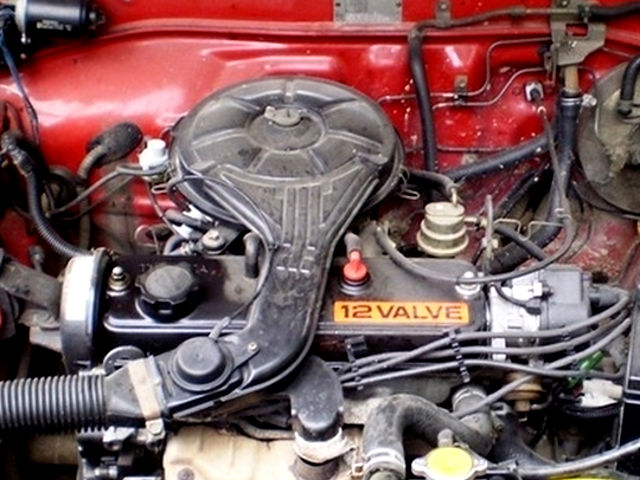
 The Toyota 2E is a 1.3 l (1,296 cc, 79.09 cu·in) straight-four 4-stroke natural aspirated gasoline engine from Toyota E-family. The 2E engine was manufactured from 1985 to 1998.
The 2E engine features a cast-iron block and aluminum cylinder head with the single overhead camshaft (SOHC) and three valves per cylinder (12 in total).
Compression ratio rating is 9.5:1. It has a 73.0 mm (2.87 in) cylinder bore and 77.4 mm (3.05 in) piston stroke.
The engine was available in the following versions:
- 2E or 2E-L, 2E-LU It is a carburetored version of this engine. Horsepower ranged from 65.3 PS (48 kW; 64.4 HP) at 6000 rpm to 83 PS (61 kW; 81.8 HP) at 6,000 rpm with 89 N·m (9.1 kg·m, 65.6 ft·lb) at 3,600 rpm to 98 N·m (10 kg·m, 72.2 ft·lb) at 5,200 rpm of peak torque.
- 2E-E, 2E-ELU – EFI version was used on Toyota Starlet Si (Ri) Limited.
- 2E-TE, 2E-TELU – turbocharged version was used on Toyota Starlet 1300 Turbo S (Turbo R). This version was produced from 102 PS (75 KW; 100 HP) to 110 PS (81 KW; 109 HP)
- 2E-LJ – this version was used on Toyota Starlet Van (3-rd generation). Thie version was produced 73 PS (54 kW; 72 HP) at 6,000 rpm of horsepower and 101 Nm (10.3 kg⋅m; 75 lb⋅ft) at 4,000 rpm of torque.
The breakdown of the engine code is as follows:
- 2 – 2-nd generation engine
- E – Engine family
General information
| Engine Specifications | |
| Engine code | 1E |
| Layout | Four stroke, Inline-4 (Straight-4) |
| Fuel type | Gasoline (petrol) |
| Production | 1985-1998 |
| Displacement | 1.3 L, 1,296 cm3 (79.09 cu-in) |
| Fuel system |
2E, 2E-L, 2E-LU: Carburetor (Type V) 2E-E, 2E-ELU, 2E-TE, 2E-TELU: Electronic fuel injection system |
| Power adder | 2E-TE, 2E-TELU: Turbocharger |
| Power output |
2E, 2E-L, 2E-LU: 65 PS (48 kW; 64 HP) at 6000 rpm – 83 PS (61 kW; 82 HP) at 6,000 rpm 2E-TE, 2E-TELU: 102 PS (75 KW; 100 HP) to 110 PS (81 KW; 109 HP) |
| Torque output |
2E, 2E-L, 2E-LU: 89 N·m (9.1 kg·m, 66 ft·lb) at 3,600 rpm – 98 N·m (10 kg·m, 72 ft·lb) at 5,200 rpm |
| Firing order | 1-3-4-2 |
| Dimensions (L x W x H): | – |
| Weight | – |
Cylinder block
The Toyota 2E has a cast-iron cylinder block with five bearing support system. It has a 73.0 mm (2.87 in) cylinder bore and 77.4 mm (3.05 in) piston stroke. Compression ratio rating is 9.5:1.
| Cylinder block | ||
| Cylinder block alloy | Cast-iron | |
| Compression ratio: | 9.5:1 | |
| Cylinder bore: | 73.0 mm (2.87 in) | |
| Piston stroke: | 77.4 mm (3.05 in) | |
| Number of piston rings (compression / oil): | 2 / 1 | |
| Number of main bearings: | 5 | |
| Cylinder inner diameter (standard): | 73.000 mm (2.874 in) | |
| Piston skirt diameter (standard): | 72.910-72.940 mm (2.8705-2.8716 in) | |
| Piston pin outer diameter: | – | |
| Piston ring side clearance: | Top | 0.040-0.080 mm (0.0016-0.0031 in) |
| Second | 0.030-0.070 mm (0.0012-0.0028 in) | |
| Piston ring end gap: | Top | 0.260-0.490 mm (0.0102-0.0193 in) |
| Second | 0.150-0.430 mm (0.0059-0.0169 in) | |
| Oil | 0.200-0.830 mm (0.0079-0.0327 in) | |
| Crankshaft journal diameter: | 47.000 mm (1.8504 in) | |
| Crankpin diameter: | 40.000 mm (1.5748 in) | |
Main bearing cap bolts tightening procedure and torque specs:
- 57 Nm, 5.8 kg·m; 42 ft·lb)
After securing bearing cap bolts, make sure crankshaft turns smoothly by hand.
Connecting rod bearing bolts
- 39 Nm, 4.0 kg·m; 29 ft·lb)
Cylinder head
The cylinder head is made of aluminum alloy which gives it good cooling efficiency. The engine has single overhead camshaft, that is driven by a timing belt and three valves per cylinder (12 valves in total). The 2E engine used special valve shims to adjust the valve clearance.
| Cylinder head | ||
| Valve Arrangement: | SOHC, belt drive | |
| Valves: | 12 (3 valves per cylinder) | |
| Valve head diameter: | INTAKE | – |
| EXHAUST | – | |
| Valve length: | INTAKE (First) | 92.26 mm (3.6323 in) |
| INTAKE (Second) | 98.50 mm (3.8779 in) | |
| EXHAUST | 92.26 mm (3.6323 in) | |
| Valve stem diameter: | INTAKE | 5.970-5.985 mm (0.2350-0.2356 in) |
| EXHAUST | 5.965-5.980 mm (0.2348-0.2354 in.) | |
| Valve spring free length: | 41.52 mm (1.6346 in) | |
| Camshaft cam height: | INTAKE (First) | 35.87-35.97 mm (1.4122-1.4161 in) |
| INTAKE (Second) | 35.38-35.48 mm (1.3929-1.3968 in) | |
| EXHAUST | 35.83-35.93 mm (1.4106-1.4146 in) | |
| Outer camshaft journal diameter: | 26.979-26.995 mm (1.0622-1.0628 in) | |
Head tightening procedure and torque specs:
- Step 1: 29 Nm, 3.0 kg·m; 21.4 ft·lb
- Step 1: 49 Nm, 5.0 kg·m; 36.16 ft·lb
- Step 2: Turn all bolts 90°
Maintenance data
| Valve clearance | |
| Intake valve | 0.20 mm (0.008 in) |
| Exhaust valve | 0.20 mm (0.08 in) |
| Compression pressure | |
| Standard | 13.0 kg/m2 / 200 rpm |
| Minimun | 10.0 kg/m2 / 200 rpm |
| Compression differential limit between cylinders | 1.0 kg/m2 / 200 rpm |
| Oil system | |
| Oil consumption , L/1000 km (qt. per miles) | up to 0.5 (1 qt. per 1200 miles) |
| Recommended engine oil | 5W-20, 5W-30, 10W-30 |
| Oil type API | SE, SF or SG |
| Engine oil capacity (Refill capacity) |
With filter change 3.2 l l Without filter change 2.9 l |
| Oil change interval, km (miles) | 10,000 (6,000) |
| Ignition system | |
| Spark plug | NGK: BPR6EY-11 DENSO: W20EXR-U11 |
| Spark plug gap | 0.8 mm (0.031 in) or 1.1 mm (0.043 in) |
Vehicle applications
| Model | Years Produced |
| Toyota Corolla (AE92, AE111) – South Africa | – |
| Toyota Corolla (EE90, EE96, EE97, EE100) | – |
| Toyota Sprinter (EE90, EE96, EE97, EE100) | – |
| Toyota Starlet (EP71, EP81, EP82, EP90) | – |
| Toyota Starlet Van (EP76V) | – |
| Toyota Corsa | – |
| Toyota Conquest (South Africa) | – |
| Toyota Tazz (South Africa) | – |
| Toyota Tercel (Caribbean / South America) | – |
Hi dear all
Is 20W50 a suitable oil for 2E engine in meadle east (Iran Tehran) or not?
Thanks so much.
This oil is suitable for temperature ranges from -10 to +50 C°
muy agradecidos por su informacion señores
In catalog writing the oil with filter 2,8 and with filter 2,6 without here wrote 3,2 with change filter 2,9 without who is right
It depends on the car model
Thanks for publication.
Hi,
Would any body like to tell about the primary,secondary and power jet size in toyota corolla 1988 12 valve 2e engine.
Thanks
Regards
Where can i get the manual of Corolla 2E engine
Hi Nasir
I have a Manual Corolla 2E engine if you want it.
[email protected]
Hello again in 2020- I got alot of requests about the maunal.
here you will find the online Manual of Corolla 2E engine :
https://www.toyota.com/owners/resources/warranty-owners-manuals/corolla/1999
Best wishes for all
Ahmed Leila
Hi Ahmed, can i have also a copy of toyota manual 2e engine? Thanks
Number
Good morning Dear,
I need 2E engine repair manual, already searched and can not anywhere, send in pdf format. please.
hi admin. i want to ask. my engine 2E-TE. My rpm wont go pass 4000 rpm . what the problem
admin. tumpang tanya masalah enjin saya. tidak boleh rem lebih dari 4000rpm. ada solusi untuk mengatasi nya?
Hi. Please may I know the sizes of the drive belts for the 2e 1.3 corolla engine? Thanks a lot
Hi. I would like to know of you have a repair manual for a Toyota conquest 2e engine.
Can I ask a favor from the generous gentleman who can help me have a copy of service manual of Toyota Corolla 1995. In advance, I am grateful for your help.ga
Hello guys good day I would like to ask permission to all of you guys who love toyota cars regarding for the engine model.. Cos I buy e second hand toyota corolla xe but I wonder the engine model becouse I look into the registration paper is like this model Numbr 2E but caborator type I though it is a EFI.. It has changed to like this or this is coming from original market.. Please help me to know this thanks and God bless I’m from Philippines ??
Hi
Is there a torque setting for the bolts that locate the camshaft.
I’m asking for toque settings for 2e engine 1300.
Hi i am looking for a manual for a Tazz 1300 2E motor. Please if u can help me as am a pensioner Thanking yo guys a lot. Abe
Can I replace a 3e engine instead a 2e engine for ee80 COROLLA.
hi my name is sidwel i have a 13 1985 2 e the spec says my oil level should be 2 9 with out new filter but i only put two liters and it goes over the max mark what is the reason for that
What’s the valve diameters
Hi everyone…plse help me am looking for a carburator 2e manual,am based in zambia…kindly send me where I can access the item…will appreciate
hi im here in dubai so many carburator here new but made in china and used from japan
does anyone know if the AC/Heater parts for this engine are the same as the newer model 4E engine?
Has anyone encountered water seeping into the fuel mixture? Fouling the engine performance. There is water by-pass hose to the carburetor, with the water/coolant entering through the intake manifold. Can this be eliminated?
I think it’s to warm the carb body in cold temps. One day, I’m going to disconnect it.
Do wet problem of Spark Plug connected with carburetor? how could wet of spark plug with fuel could be fixed?
or headgasket. Look inside through sparkplug hole which cylinders have water
ラブドール 子供が成形した小規模なダッチワイフが小児性愛に与える影響3Esdollオンラインストアで最も美しい厳選された大人の人形賢明なダッチワイフを崇拝する多くの動機があります現実的なダッチワイフは低セックスドライブ中に代理人として動きます
may I have engine torque settings Toyota Corolla 2E, EE110, especially big end bearing caps bolts, main bearing caps bolts and cylinder head bolts.
There are many complaints about 8xbet online.Visit us: metalcreation.in.net
A number of review sites mention problems with britnibracht.za.com. The address listed (Hanoi) and phone don’t match typical licensed o“Service Centre” Hides Online Betting Risks
Users should stay very cautious with elemental.sa.com. It uses typical urgency tactics for depo– Check Before Depositing
The 2e 1.3cc engine is the original Toyota Corolla 1.3 SE sporty saloon ee80 specifically for the Indonesian market since the year of production and sales in 1985-1987 limited edition by PT. Toyota Astra Motor Sunter North Jakarta, well, the difference between the improvements from 1985-1987 is that the size of the engine room is different. 1985-1986 was large and less compact, while the final 1987 improvement had a compact engine room.
The Toyota 2E engine, produced between 1985 and 1998, showcases a robust design with its aluminum cylinder head and cast-iron block. It’s fascinating how the engine variants, like the turbocharged 2E-TE version used in the Starlet 1300 Turbo S, can deliver impressive horsepower. Just like finding the perfect lace bodysuits, choosing the right engine variant can make all the difference in performance.
This was a thoughtful post. The details in “Toyota 2E” gave me a few ideas to try. https://littlebeartools.com
Mass link tactics usually show up fast in referral logs, which is why I test traffic quality with small games. One useful example is Guess the song since it reveals real user engagement and sharing behavior without any install. Watching those signals helps separate actual visitors from bot noise.
Good write-up. “Toyota 2E” explains the topic in a way that feels easy to digest. passport photo maker相关介绍
Fascinating look at the Toyota 2E. I appreciate how the piece places the engine in its era and highlights its design choices. It would be great to add concrete specs like displacement output torque and fuel economy, plus how it compares with competing engines of the time. Tips on maintenance common failure modes and availability of parts would help readers who are restoring or keeping these engines on the road. Overall an insightful read for gearheads.
I had no idea the 2E ran from 1985 to 1998, which explains why finding specific cast-iron block parts can be such a hassle today. While hunting for those rare components, I actually used bulin 47ai to turn a photo of my old Corolla into a freestyle video just for fun.
Specs section came back empty, which is a shame since the 2E is one of the weirder Toyota engines to dig into. Anyone actually know the bore/stroke and stock output figures offhand?
The 2E was a pretty simple little workhorse, but it’s interesting how long those Toyota engines kept running with basic maintenance. Curious to see the exact specs like compression ratio and power figures.
The 2E’s 9.5:1 compression ratio and 73 mm bore/77.4 mm stroke give it a compact yet robust character, which explains why the 2E‑TE turbo variant can push 110 hp from the same displacement. The use of a single overhead cam with three valves per cylinder is a clever compromise between performance and manufacturing simplicity, especially for the early 1990s Toyota Starlet lineup.
PDF Dark — Invert PDF gives you three ways to handle images: leave them untouched, auto-detect, or invert them along with the page.
The 2E’s 9.5:1 compression ratio and 73 mm bore/77.4 mm stroke give it a modest 65–83 hp range, which explains why it was popular in compact models like the Starlet. Its single‑SOHC, 12‑valve layout keeps the engine light and reliable, but the lack of a dual‑cam design limits high‑RPM power compared to later Toyota engines.
If you want a random Pokemon generator, this one runs fully in the browser with no signup.
This is the kind of practical content that is worth bookmarking. Appreciate the effort. https://redtigerdashcam.net
Nếu bạn đã quen với biến động của BTC – Bitcoin , hãy nhớ rằng MOONSHOTUSDT có mức độ rủi ro cao hơn nhiều do thiếu thị trường tham chiếu công khai
Budgeting for change usually means tracking every cost, but image files can quietly carry metadata that adds unseen risks. If you share visuals from webinars, an ai metadata remover strips EXIF, GPS, XMP and C2PA without recompressing, so your files stay lossless and ready.
Nếu bạn đã quen với biến động của BTC – Bitcoin , hãy nhớ rằng MOONSHOTUSDT có mức độ rủi ro cao hơn nhiều do thiếu thị trường tham chiếu công khai
If you’re taking a break from all the technical deep dives into Toyota engines and want to enjoy some classic gaming nostalgia, I highly recommend checking out this browser arena fighter. It lets you experience Dragon Ball Z: Budokai Tenkaichi 3 directly in your browser—no downloads or emulators needed. It’s perfect for quick, action-packed battles right from your desktop, and the setup is super easy for both keyboard and controllers. Give it a try here: browser arena fighter
If you’re a fan of classic engines and retro gaming, you’ll want to check out Budokai T3 Web Online. It lets you play Dragon Ball Z: Budokai Tenkaichi 3 directly in your browser with no downloads or installation needed. The experience is seamless, runs at 60 FPS, and works on any device—even school or work computers. If you’re looking for a fun break after reading about Toyota’s 2E engine specs, you should definitely try Budokai T3 Web Online—it’s a great way to relive some nostalgic PS2 action!
If you’re interested in exploring innovative ways to enjoy classic and modern games directly in your browser, I highly recommend checking out AI Browser Games. It’s a well-curated directory for browser-based titles, including detailed guides and setup notes. Whether you’re a gamer or a tech enthusiast, it’s a great resource for discovering new projects and understanding the technology behind them.
It’s wild to think this 1.3L cast-iron block was cranking out power from ’85 all the way through ’98, showing just how reliable Toyota’s E-family designs really were. While I’m busy digging into these vintage specs for my project car, I’m also testing out some of the newest bestest model api on token-king.com to handle other tech tasks.
Awesome article. I have great news for and it’s about the latest bybit invitation code New users can use the referral code 56612 for this year during registration to become eligible, along with exclusive welcome rewards, trading incentives, and promotional benefits available to qualifying accounts. I can’t wait to see more of this. Good luck.
Nice article you’ve written. Please I just want to let you all know about the latest bybit australia review New users can use the referral code 56612 for this year during registration to become eligible, along with exclusive welcome rewards, trading incentives, and promotional benefits available to qualifying accounts. This is the new version of the food.
Well put together. I like posts that are direct but still give enough context. 这个网站
I had no idea the 2E had a turbocharged variant that pushed 110 HP, that’s way more than the carb versions I’ve seen swapped into old Starlets problematic prompt generator
Great write-up on the 2E! I appreciate the detailed breakdown of the different versions—especially the carbureted vs. EFI specs. It’s not often you see the 2E-LJ van variant covered, so that was a nice bonus. I’ve been tinkering with a Starlet for a while, and this forum is exactly the kind of resource I was looking for. When I need a break from the garage, I also enjoy reading through a little blog called tiệm trà sữa nhỏ—it’s a nice way to unwind while still soaking up car culture. Thanks for putting this space together; I’m looking forward to more discussions and shared experience from other 2E owners.
Interesting read on the Toyota 2E! It’s amazing how versatile this little 1.3L engine was, from the carbureted base version to the turbocharged Starlet models. The SOHC three-valve design might be simple by modern standards, but it clearly delivered reliable performance for over a decade. I’ve always appreciated how Toyota squeezed decent power and torque across so many variants, and it’s no surprise these engines are still talked about in enthusiast circles. For anyone restoring one of these or just diving into engine specs, it’s worth noting that the breakdown of the engine code and the different EFI/turbo versions make a big difference when sourcing parts. By the way, if you’re ever documenting builds or sharing technical details on forums, you might find letras diferentes e simbolos handy for spicing up text in a creative way. Thanks for putting this guide together — it’s a helpful reference for 2E owners and fans.
Great breakdown of the Toyota 2E engine! I’ve owned a Starlet with the carbureted 2E-LU, and it was incredibly reliable for such a small motor. The SOHC, 12-valve design is simple but effective, and it’s fascinating to see how the platform spawned everything from economy carb versions to the turbocharged 2E-TE with 110 PS. The torque curves and production years are well documented here. I also appreciate the clear explanation of the engine code breakdown—helpful for anyone researching vintage Toyotas. This kind of detailed technical reference reminds me of the deep-dive lore databases fans build for fantasy series like dragonkind fourth wing; both show how communities love preserving intricate details. Thanks for putting this together—definitely bookmarking this for future reference!
op37 App ကို official download entrance မှသာ ဒေါင်းလုဒ်ဆွဲရန် အကြံပြုပါသည်။ မသိသော APK link များနှင့် third-party website များကို သတိထားပါ။
Ban ca tien là trò chơi giải trí thú vị, nhưng nếu bạn cũng thích thử thách trí tuệ mỗi ngày thì nên xem dlenow.com. Trang này có nhiều game đoán chữ, địa lý, âm nhạc, phim theo phong cách Wordle, kèm luật chơi và mẹo hữu ích. Rất đáng để thử khi rảnh rỗi.
Great to see a dedicated forum for the Toyota 2E! This engine has such a loyal following, and it’s nice to have a place where owners can exchange tips and troubleshooting advice. I’ve always appreciated the simplicity of the carbureted 2E, especially how easy it is to work on compared to modern engines. The 2E-TE turbo version is fascinating too—it must have been a blast in the Starlet. By the way, for anyone maintaining these older engines and needing to share technical documents or manuals in Bangla, I found a helpful resource on how to convert Unicode to Bijoy which makes formatting old service sheets much easier. Thanks for putting this community together; I’m looking forward to reading everyone’s experiences and learning more about the different 2E variants!
Great to see a dedicated forum for the Toyota 2E! This engine was a workhorse in its day—simple, robust, and surprisingly lively for a 1.3L, especially in the turbocharged Starlet versions. I’ve owned a carbureted 2E in a Corolla and always appreciated how easy it was to work on, though tuning the carburetor took some patience. The detailed specs you’ve provided, especially the breakdown of the different versions, are really helpful for anyone restoring or maintaining one of these cars. If anyone here is working with old service manuals or translated documents, I’ve also found a handy tool for converting Bengali text—check out Bijoy2Unicode—which makes reading scanned manuals much easier. Looking forward to learning from everyone’s experience with the 2E!
The 2E-TE making up to 110 PS in a little Starlet must’ve been a riot, especially with that simple SOHC setup. period tracker online
“Toyota 2E” was a useful read. I liked the practical tone and clear structure. 推荐看看name dictionary
Nice bit of nostalgia here — forgot the 2E was a 1.3 straight-four that Toyota kept in production from 1985 to 1998. My uncle ran an old Corolla powered by one of these for years and it refused to die, so those dates track with how long that engine stuck around.
Random aside since this post has nothing to do with football: I tried Ozil Goal AI last weekend to clip a goal from our five-a-side match into a short reel for the group chat, and it did the job without much fiddling on my end. Weird combo of topics in my head today, I know.
Setting goals is one thing, but tracking progress visually helps me stay motivated. I often photograph milestones, and before sharing them I use Remove AI label to strip embedded C2PA and EXIF metadata right in the browser, no upload needed. That keeps my progress photos clean while I focus on the next goal.
The turbo Starlet version making up to 110 PS is the bit that makes this little 1.3 interesting—calculate margin the regular carbureted versions sound like honest, simple workhorses too.
Nice to see a clean spec page for the 2E — 1,296 cc, naturally aspirated, and a production run from 1985 to 1998 covers a lot of Corollas, Starlets and Tercels, so this is the kind of reference I’d want open while poking around an older engine bay.
What I like about a page like this is that it’s all numbers and no fluff, which is pretty much how I approach football too. That’s where Ozil Goal comes in for me — I use it as a prediction tool when I’m looking at upcoming matches, and I keep it bookmarked at https://ozil-goalai.org/ alongside the usual reference tabs. Different subject entirely, same habit of checking the figures before I make up my mind.
The 1985–1998 production range and 1.3-liter displacement are the details I’d want up front when looking at the Toyota 2E, so this is a useful reference for the E-family.
I’ve been using PlanLiva to keep notes like these from getting scattered when I compare engine specs.
Harsh overhead illumination casts steep shadows under the brow line and jaw, causing computer vision models to register false hollows. For accurate coordinate mapping on the Looksmax Scale Attractiveness Test, soft, diffused front lighting keeps facial contours evenly visible.
Creative blocks often come from too much passive input, so quick interactive breaks can reset focus. If you want to sharpen reactions while switching tasks, you can Play okiaimx online to practice peek timing and crosshair control in short browser sessions.
110 PS from the 2E-TE in a Starlet 1300 Turbo S is properly mental for a 1.3L, and that turbo badge alone is why half of us keep buying these old Starlets. Full specs here if anyone else wants to nerd out: free concrete calculator
If you enjoy exploring engines like the Toyota 2E and have a passion for classic technology, you might also be interested in classic and retro games that run directly in your browser. I recently found Ported 2 Browser, a curated directory of classic and modern games you can play instantly without any downloads. It’s a great way to take a break and enjoy some nostalgia or discover new titles—definitely worth checking out for any enthusiast!
If you’re taking a break from reading up on engine specs and are looking for a bit of fun, I highly recommend checking out the browser-based version of the classic Cricket 07 game. No need to download or install anything—just play instantly and relive the excitement with easy controls and full match features. Perfect for cricket fans who want a quick and hassle-free gaming experience. Give it a try here: Cricket 07
The 2E’s three-valve SOHC setup and 73.0 mm bore are a neat detail; I even opened this free online tool to picture the valve layout, though that was a detour.
The 2E is a simple, tough little engine, and the turbocharged Starlet version making up to 110 PS is pretty cool for a 1.3L from that era. concrete calculator Toyota really knew how to build small engines that could take a beating.
It’s wild to think that a 1.3L cast-iron block from the late 80s could still be relevant today, especially with how lightweight modern builds are now. While you’re digging into these classic specs, check out Uptown Funk AI if you want to turn a single photo of your engine bay into a groovy dance clip.
Always had a soft spot for the 2E. My uncle had an old Corolla with that 1.3L workhorse, and it felt practically indestructible despite how simple the setup was under the hood.
I was actually putting together some vintage-style garage prints recently and used GPT Image 2.5 to draft a cutaway diagram mockup. Took a couple of prompt tweaks to get the manifold placement right, but it managed to render the small oil filter and belt labels legibly without blurring out the surrounding line work.
The 2E’s 9.5:1 compression ratio and 73 mm bore give it a modest 65–83 PS range, which is typical for a naturally aspirated 1.3‑liter engine of its era. Its cast‑iron block with five main bearings provides durability, but the single‑overhead‑cam, three‑valve layout limits high‑RPM breathing compared to later DOHC designs.
Someone put together a guide to the Malfoid trend that collects the fan art, fics and even the dating sims.
The 2E-TE Starlet Turbo S task manager was a proper little rocket for a 1.3 back then, and the fact Toyota was still building this engine in ’98 honestly says more about their engineering than most modern platforms.
Good overview of the 2E specs, though a couple of points could use more detail. The three-valve-per-cylinder layout is worth emphasizing since it’s unusual and explains part of the engine’s breathing characteristics. It would also help to clarify which variants were carbureted versus EFI and which markets received the 2E-TE turbo, since the article cuts off there. The horsepower and torque ranges are useful, but noting the rpm spread across versions makes it easier to see how the tuning differed. One small correction: the 2E displacement is often quoted as 1,295 cc rather than 1,296 cc depending on the source, so a note on rounding would avoid confusion.
The three-valve SOHC setup on a 1.3 L engine is unusual, and the detail about valve shims makes the 2E feel like a real mechanic’s engine; Outstanding Tiny Desk AI: One Photo Behind the Desk the 1985–1998 run also fits its wide use in Corollas and Starlets.
A friend dragged me up Arrigetch way back and I still measure hikes by that scree. Funny how the obscure route always wins. Same joy here: krillion rewards the uncommon answer, not the obvious one. 7 prompts, 25 seconds, no sign-up. Worth a snowed-in evening.
It’s wild how the 2E stayed in production for over a decade with such simple specs like the cast-iron block. I was just messing around making a tribute track about this engine using an ai rap generator to see if it could capture that 90s vibe. The tool actually turned my rough notes into a solid freestyle video template pretty quickly.
After practice: Before the party: After rehearsal: Between posts: At dawn: While the vampire costume phone shot was still on my phone, I picked the pet style. I pointed people to sports photo I’m so sorry trend. Halloween style opens on English. Childhood, sports, selfie and pet are in the same tool.
It’s fascinating to see the technical details of the Toyota 2E, especially how it evolved from a carbureted version to later fuel-injected models. The cast-iron block and aluminum cylinder head combination really highlights why these engines are so durable for older vehicles. I found the maintenance data section particularly useful when working on my family’s older car with this engine. For anyone else looking for more specific information on Japanese automotive history, you can check out このサイト.
The 1985 to 1998 run is a long stretch for a 1.3-liter four, and it’s a good reminder of how far the E-family carried across so many models. Spec pages like this are handy when you just want displacement and years without digging through forum threads.
That kind of quick reference reading is where I tend to keep Tiny Desk AI open, and tiny-deskai.org is where I came across it. It’s fine for jotting and re-checking details while I skim, though for anything serious I’d still go to the service manual.
Interesting specs on the Toyota 2E engine. Reminds me of how quickly technology evolves, even in creative fields like turning photos into videos. photo to video AI