
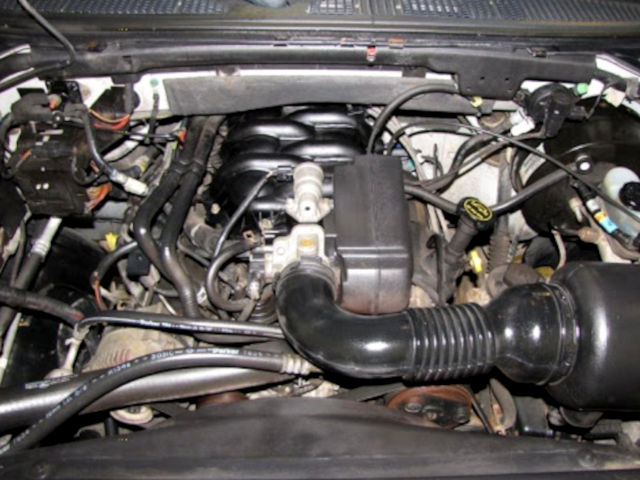
 The Ford Essex V6 4.2 L is a 4.2 L (4,195 cc, 256.0 cu·in) V6, four-stroke cycle water-cooled naturally aspirated internal combustion gasoline engine, manufactured by Ford Motor Company form 1997 to 2008.
The Ford Essex V6 4.2 L engine has 6 cylinders in a V arrangement at a bank angle of 90° The Essex V6 4.2 L engine features a cast-iron cylinder block with a four-bearings crankshaft and two aluminum heads with two overhead valves per cylinder (12 in total). The Ford Essex V6 4.2 L engine is equipped with electronic fuel injection system.
The cylinder bore is 96.83 mm (3.81 in) and the piston stroke is 95.0 mm (3.74 in). Compression ratio rating is 9.3:1. The Ford Essex V6 4.2 L engine produced 208 PS (153 kW; 205 HP) at 4,750 rpm of maximum power and 346 N·m (35.3 kg·m, 255.0 ft·lb) at 3,000 rpm of maximum torque.
General information
| Engine Specifications | |
| Engine code | Ford Essex V6 4.2 L |
| Layout | Four stroke, V6 |
| Fuel type | Gasoline (petrol) |
| Production | 1997-2008 |
| Displacement | 4.2 L, 4,195 cm2 (256.0 cu in) |
| Fuel system | Electronic fuel injection system |
| Power adder | None |
| Power output | 208 PS (153 kW; 205 HP) at 4,750 rpm |
| Torque output | 346 N·m (35.3 kg·m, 255.0 ft·lb) at 3,000 rpm |
| Firing order | 1-4-2-5-3-6 |
| Dimensions (L x W x H): | – |
| Weight | – |
Cylinder block
The Ford Essex V6 4.2 L engine has cast-iron cylinder block in a V arrangement at a bank angle of 90°. This engine’s firing order is 1-4-2-5-3-6. The crankshaft is supported by 4 bearings.
Each piston is equipped with two compressions and one oil control rings. The cylinder bore is 96.83 mm (3.81 in) and the piston stroke is 95.0 mm (3.74 in). Compression ratio rating is 9.3:1.
| Cylinder block | ||
| Cylinder block alloy | Cast-iron | |
| Compression ratio: | 9.3:1 | |
| Cylinder bore: | 96.83 mm (3.81 in) | |
| Piston stroke: | 95.0 mm (3.74 in) | |
| Number of piston rings (compression / oil): | 2 / 1 | |
| Number of main bearings: | 4 | |
| Cylinder inner diameter (standard): | 96.800 mm (3.810 in) | |
| Piston skirt diameter (standard): | 96.795 mm (3.810 in) | |
| Piston pin outer diameter: | – | |
| Connecting rod bushing inner diameter: | – | |
| Piston ring side clearance: | Top | 0.030-0.080 mm (0.00122-0.00315 in) |
| Second | 0.030-0.080 mm (0.00122-0.00315 in) | |
| Piston ring end gap: | Top | 0.250-0.410 mm (0.0098-0.0161 in) |
| Second | 0.380-0.640 mm (0.0149-0.0250 in) | |
| Oil | 0.150-0.650 mm (0.0059-0.0640 in) | |
| Crankshaft main journal diameter: | 62.968-62.992 mm (2.5190-2.5198 in) | |
| Crankpin diameter: | 58.682-58.702 mm (2.3103-2.3111 in) | |
Cylinder head
The cylinder head is made of aluminum alloy. The Essex V6 4.2 L engine has two overhead valves per cylinder, pushrods, rocker arms.
| Cylinder head | ||
| Block head alloy | Aluminium | |
| Valve Arrangement: | OHV | |
| Cylinder head height: | – | |
| Valves: | 12 (2 valves per cylinder) | |
| Intake valve timing: | – | |
| Exhaust valve timing: | – | |
| Valve seat angle: | INTAKE | 44.75° |
| EXHAUST | 44.75° | |
| Valve face angle: | INTAKE | 45.675° |
| EXHAUST | 45.675° | |
| Valve seat width: | INTAKE | 1.5-2.0 mm (0.060-0.080 in) |
| EXHAUST | 1.5-2.0 mm (0.060-0.080 in) | |
| Valve head diameter: | INTAKE | 47.27 mm (1.86 in) |
| EXHAUST | 37.10 mm (1.46 in) | |
| Valve length: | INTAKE | – |
| EXHAUST | – | |
| Valve stem diameter: | INTAKE | 8.674-8.694 mm (0.3415-0.3423 in) |
| EXHAUST | 8.664-8.682 mm (0.3410-0.3418 in) | |
| Valve spring free length: | INTAKE | 50.500 mm (1.990 in) |
| EXHAUST | 50.500 mm (1.990 in) | |
| Camshaft lobe height: | INTAKE | 42.31-42.41 mm (1.6657-1.6697 in) |
| EXHAUST | 41.96-42.06 mm (1.652-1.6559 in) | |
| Camshaft journal diameter: | 26.949-26.965 mm (1.061-1.0616 in) | |
Maintenance data
| Oil system | |
| Recommended engine oil | SAE 5W-20 |
| Oil type API | – |
| Engine oil capacity (Refill capacity) | With filter change 5.7 liters (6.0 US qts, 5.0 Imp. qts) |
| Oil change interval, km (miles) | 8,000 (5,000) |
| Oil Pressure | At 2,500 rpm: 245-520 kPa (2.5-5.3 kg/cm2, 40-125 psi) |
| Ignition system | |
| Spark plug | Ford AGSF34EE |
| Spark plug gap | 1.32-1.42 mm (0.052-0.056 in) |
Vehicle applications
| Model | Years Produced |
| Ford F-150 | 1997–2008 |
| Ford E-150 | 1997–2003 |
| Ford E-250 | 1997–2003 |
| Ford F-250 | 1998–2001 |
| Ford Freestar | 2004–2007 |
| Mercury Monterey | 2004–2007 |
Question: In a v6 2-valves per cylinder, how can it have 14 valves?
A classic British V6, known for its smooth power.
The 90° bank angle and cast-iron block make the 4.2 L Essex V6 an interesting example of Ford’s durable, traditional engine design. It would be useful to compare its real-world reliability and fuel consumption across the 1997–2008 production years.
The 90° V arrangement and cast-iron block make the Essex 4.2 L an interesting example of Ford’s durable, naturally aspirated V6 design. It would be helpful to compare its four-bearing crankshaft layout with the related 3.8 L version.
The 90° bank angle and cast-iron block are interesting details of the Ford Essex V6 4.2 L. It would be useful to compare this naturally aspirated version’s durability and torque with the smaller Essex engines.
The 90° V configuration and cast-iron block make the 4.2 L Essex V6 a particularly interesting engine for studying Ford’s long-running truck powertrain design. I’d be curious to hear about its common reliability issues and real-world fuel economy.
The 90° bank angle and cast-iron block explain why the 4.2 L Essex V6 earned a reputation for durability. It would be interesting to compare its four-bearing crankshaft design with the later Ford V6 revisions.
The 90° V arrangement and cast-iron block explain why this naturally aspirated 4.2 L Essex V6 earned a reputation for durability. It would be useful to include common issues and maintenance tips for engines produced from 1997 to 2008.
The 90° V arrangement and cast-iron block make this 4.2 L Essex V6 an interesting example of Ford’s durable truck-oriented design. I’d be curious to know which model years received the most significant updates between 1997 and 2008.
The 90° bank angle and cast-iron block explain why this naturally aspirated 4.2 L V6 has such a sturdy design. It would be interesting to compare its four-bearing crankshaft durability with the smaller Essex variants.