
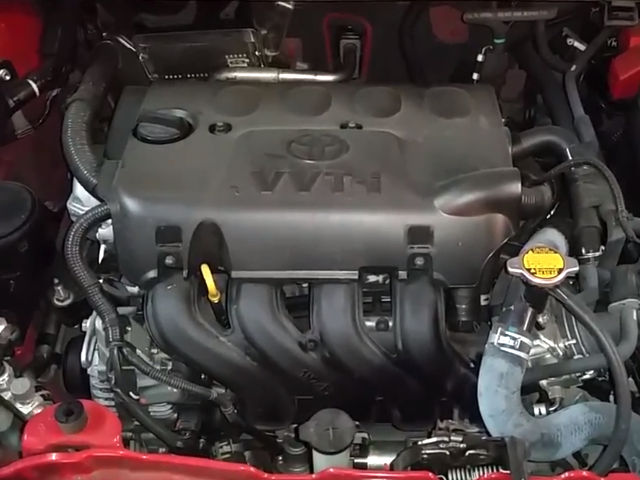
|
The Toyota 1NZ-FE is a 1.5 L (1,497 cc, 91.35 cu-in) straight-four 4-stroke naturally aspirated gasoline engine from the Toyota NZ family. It was introduced in 1999 to replace the 5A-FE and 5E-FE 1.5 L engines. The 1NZ-FE has been built at the Kamigo Plant in Japan since 1999, and also by Siam Toyota Manufacturing in Thailand for the Yaris and Vios.
The 1NZ-FE features a lightweight aluminum block and aluminum cylinder head with two overhead camshafts (DOHC), four valves per cylinder (16 in total) and a timing chain drive. The compression ratio is 10.5:1 (11.0:1 on Japanese-market versions updated in 2012). Cylinder bore and piston stroke are 75.0 mm (2.95 in) and 84.7 mm (3.33 in), respectively.
The engine has a multi-point electronic fuel injection system, VVT-i (Variable Valve Timing with intelligence) on the intake camshaft, and a DIS-4 ignition system with an individual ignition coil for each spark plug. Later engines have ETCS-i (Electronic Throttle Control System-intelligent); early engines have a mechanical throttle with an idle speed control valve.
Depending on the version and market, the 1NZ-FE produces 98-110 PS (72-81 kW; 97-108 HP) at 6,000 rpm and 127-143 Nm (13-14.6 kg·m; 94-105.6 ft·lb) of torque at 4,200-4,800 rpm. The maximum figures are 110 PS (81 kW; 109 HP) and 143 Nm (14.6 kg·m; 105.6 ft·lb).
The breakdown of the engine code is as follows:
- 1 – 1-st generation engine
- NZ – Engine family
- F – Economy narrow-angle DOHC
- E – Multi Point Fuel Injection
Engine versions: type ’99 and type ’03
In 2003 the engine was revised to meet Euro IV (STEP IV) emission rules. The following changes were made:
- Piston shape was changed;
- The shape of the exhaust manifold was modified;
- Construction of the three-way catalytic converter was changed;
- The 16 bit ECU was changed to 32 bit.
Separately, from September 2003 (first fitted to the front-wheel-drive Sienta XP80), Japanese-market models received a 1NZ-FE with a new cylinder head. Owners and workshops call it the type ’03 engine, and the earlier design the type ’99 engine. The two versions differ in several ways that matter for maintenance and parts:
| Type ’99 and type ’03 compared | ||
| Feature | Type ’99 | Type ’03 |
| Valve train | Bucket-type valve lifters (tappets); clearance is adjusted by changing lifter thickness | Roller rocker arms and hydraulic lash adjusters; no valve adjustment |
| Angle between valves | 33° | 21° |
| EGR system | No | Yes, with EGR cooler |
| Thermostat opening | About 82°C | About 88°C |
| Throttle | Mechanical on early engines; ETCS-i on export engines from 2005 | ETCS-i |
| Spark plugs | Denso K16R-U11 / NGK BKR5EYA-11; iridium Denso SK16R11 on export engines from 2005 | Iridium: Denso FK20HR11 / NGK ILFR6D11 |
| Where fitted | All engines before September 2003; export models such as the Yaris, Echo, Vios and Scion xA/xB throughout their production | Most Japanese-market models from September 2003 (Corolla E120 front-wheel drive from the April 2004 facelift); some export markets such as Hong Kong, Macau and New Zealand |
The type ’03 engine can be recognized by a different plastic engine cover. See the vehicle applications table below for the version used in each model.
General information
| Engine Specifications | |
| Engine code | 1NZ-FE |
| Layout | Four stroke, Inline-4 (Straight-4) |
| Fuel type | Gasoline (petrol), RON 91 or higher |
| Production | July 1999 – present (the updated type ’03 version is still used in Japan in the Probox/Succeed) |
| Displacement | 1.5 L, 1,497 cm3 (91.35 cu in) |
| Fuel system | Electronic Multi Point Fuel Injection (EFI) |
| Power adder | None (a TRD turbo kit was sold as a dealer option in Japan) |
| Power output | 98-110 PS (72-81 kW; 97-109 HP) at 6,000 rpm, depending on version and market |
| Torque output | 127-143 Nm (13-14.6 kg·m; 94-105.6 ft·lb) at 4,200-4,800 rpm, depending on version and market |
| Firing order | 1-3-4-2 |
| Timing drive | Single-row roller chain, 8.0 mm pitch |
| Weight | 87 kg (191.2 lbs) |
Cylinder block
The Toyota 1NZ-FE has an aluminum open-deck cylinder block with a five-bearing crankshaft support and thin-walled cast iron liners. It has a 75.0 mm (2.95 in) cylinder bore and 84.7 mm (3.33 in) piston stroke. The engine has two compression rings and a single oil control ring.
The steel connecting rods have caps that are held by plastic region tightening bolts. The engine is equipped with aluminum alloy pistons, semi-floating type piston pins and low-tension rings (two compression and single oil control ring).
| Cylinder block | ||
| Cylinder block alloy | Aluminium | |
| Compression ratio: | 10.5:1 (11.0:1 on Japanese-market versions updated in 2012) | |
| Cylinder bore: | 75.0 mm (2.95 in) | |
| Piston stroke: | 84.7 mm (3.33 in) | |
| Number of piston rings (compression / oil): | 2 / 1 | |
| Number of main bearings: | 5 | |
| Cylinder inner diameter (standard): | 75.000-75.013 mm (2.9528-2.9533 in) | |
| Piston skirt diameter (standard): | 74.945-74.955 mm (2.9506-2.9510 in) | |
| Piston pin outer diameter: | 18.001-18.004 mm (0.7087-0.7088 in) | |
| Piston ring side clearance: | Top | 0.030-0.070 mm (0.0012-0.0028 in) |
| Second | 0.020-0.060 mm (0.0008-0.0024 in) | |
| Oil | 0.070-0.150 mm (0.0028-0.0059 in) | |
| Piston ring end gap: | Top | 0.25-0.35 mm (0.0098-0.0138 in) |
| Second | 0.35-0.50 mm (0.0138-0.0197 in) | |
| Oil | 0.10-0.35 mm (0.0039-0.0138 in) | |
| Crankshaft journal diameter: | 45.988-46.000 mm (1.8106-1.8110 in) | |
| Crankpin diameter: | 39.992-40.000 mm (1.5745-1.5748 in) | |
Main bearing cap bolts tightening procedure and torque specs:
- Step 1: 22 Nm; 2.2 kg·m; 16.2 ft·lb
- Step 2: Turn all bolts 90°
After securing bearing cap bolts, make sure crankshaft turns smoothly by hand.
Connecting rod bearing bolts
- Step 1: 15 Nm; 1.5 kg·m; 11 ft·lb
- Step 2: Turn bolts 90°
Crankshaft pulley bolt
- 128 Nm; 13.0 kg·m; 94.5 ft·lb
Drive plate (A/T) fixing bolts
- 88 Nm; 8.8 kg·m; 65 ft·lb
Cylinder head
The cylinder head is made of aluminum alloy, which gives it good cooling efficiency. The engine has a dual overhead camshaft design with four valves per cylinder, a pentroof type combustion chamber and cross-flow manifolds.
The 1NZ-FE uses the Variable Valve Timing with intelligence system (VVT-i) on the intake camshaft; the VVT-i sprocket has a 40° adjustment range. Intake valves are 30.5 mm (1.20 in) in diameter, and the exhaust valves are 25.5 mm (1.00 in). The timing drive is a single-row roller chain with a hydraulic tensioner, lubricated by a separate oil nozzle.
The valve train depends on the engine version. The type ’99 engine has no hydraulic lifters: bucket-type valve lifters of different thickness are used to adjust the valve clearance. The type ’03 engine has roller rocker arms and hydraulic lash adjusters, so its valve clearance is not adjustable.
| Cylinder head | ||
| Valve arrangement: | DOHC, chain drive | |
| Valves: | 16 (4 valves per cylinder) | |
| Valve head diameter: | Intake | 30.5 mm (1.20 in) |
| Exhaust | 25.5 mm (1.00 in) | |
| Valve length: | Intake | 89.25 mm (3.5138 in) |
| Exhaust | 87.90 mm (3.4606 in) | |
| Valve stem diameter: | Intake | 4.970-4.985 mm (0.1957-0.1963 in) |
| Exhaust | 4.965-4.980 mm (0.1955-0.1961 in) | |
| Valve spring free length: | 45.05-45.15 mm (1.774-1.778 in) | |
| Camshaft cam height: | Intake | 44.617-44.717 mm (1.7566-1.7605 in) |
| Exhaust | 44.666-44.766 mm (1.7585-1.7624 in) | |
| Camshaft journal diameter (No. 1): | 34.449-34.465 mm (1.3563-1.3569 in) | |
| Camshaft journal diameter (other journals): | 22.949-22.965 mm (0.9035-0.9041 in) | |
Head tightening procedure and torque specs:
- Step 1: 29 Nm; 3.0 kg·m; 21 ft·lb
- Step 2: Turn all bolts 90°
- Step 3: Turn all bolts another 90°
Camshaft timing sprocket
- 64 Nm; 6.5 kg·m; 47 ft·lb
Maintenance data
| Maintenance data | |
| Valve clearance (type ’99 engine only; the type ’03 engine is not adjustable) | |
| Intake valve | 0.15-0.25 mm (0.006-0.010 in) |
| Exhaust valve | 0.25-0.35 mm (0.010-0.014 in) |
| Compression pressure | |
| Standard | 15.0 kg/cm2 (213 psi) at 200 rpm |
| Minimum | 11.0 kg/cm2 (156 psi) at 200 rpm |
| Difference limit between cylinders | 1.0 kg/cm2 at 200 rpm |
| Oil system | |
| Oil consumption (normal), L/1,000 km (qt per miles) | up to 0.5 (1 qt per 1,200 miles) |
| Recommended engine oil | 5W-30, 10W-30 (0W-20 only where your owner’s manual lists it) |
| Oil type API | SJ or higher |
| Engine oil capacity | With filter change: 3.7 L (3.9 US qt) Without filter change: 3.4 L (3.6 US qt) |
| Oil change interval, km (miles) | 5,000-10,000 (3,000-6,000) |
| Ignition system | |
| Spark plug, type ’99 engine | DENSO: K16R-U11, NGK: BKR5EYA-11 (iridium Denso SK16R11 on export engines from 2005) |
| Spark plug, type ’03 engine | DENSO: FK20HR11, NGK: ILFR6D11 (iridium) |
| Spark plug gap | 1.1 mm (0.043 in) |
SPECIFICATION SHEET AND SERVICE DATA (PDF)
Maintenance Guidelines
- Oil grade: Use 5W-30 or 10W-30 (API SJ or higher). Thicker oils such as 20W-50 are not on Toyota’s recommended list and may flow too slowly on cold starts and load the oil pump, so many owners and workshops advise against them; for very hot climates, follow the grade table in your owner’s manual. Full synthetic oil is a good choice.
- Oil change interval: 5,000-10,000 km (3,000-6,000 miles). Use the short end for city driving, short trips and dusty roads. Clean oil also protects the VVT-i system and the piston rings.
- Timing chain: It has no scheduled replacement interval. Start inspecting it from about 150,000 km (93,000 miles), and when replacing it, change the sprockets, tensioner and guides together.
- Valve clearance: On the type ’99 engine, check and adjust the clearance if the engine ticks or at the interval in your owner’s manual. The type ’03 engine has hydraulic lash adjusters and needs no adjustment.
- Spark plugs: Change them at the interval in your owner’s manual. Iridium plugs on the type ’03 engine have a long threaded portion, so use the exact plug listed for your engine version.
- Idle and throttle: If the idle speed is unstable, clean the throttle body, the idle speed control valve, the air flow sensor and the PCV valve before replacing parts.
Valve clearance adjustment data (type ’99 engine)
Calculate the thickness of the new valve lifter so that the valve clearance comes within the specified values.
- R = thickness of the removed valve lifter
- N = thickness of the new valve lifter
- M = measured valve clearance
Intake: N = R + [M – 0.20 mm (0.008 in)]
Exhaust: N = R + [M – 0.30 mm (0.012 in)]
Valve lifters are available in 35 sizes, from 5.06 mm (0.1992 in) to 5.74 mm (0.2259 in), in steps of 0.02 mm (0.0008 in).
Example (intake valve): R = 5.10 mm, M = 0.52 mm, so N = 5.10 + (0.52 – 0.20) = 5.42 mm.
Toyota 1NZ-FE Common Problems & Reliability
The NZ family is considered a successful series without a specific critical defect, unlike the AZ head-bolt problem or the chronic oil burning of the ZZ series. Most 1NZ-FE problems are age-related and depend on how well the oil was changed. The power of the 1NZ-FE is adequate mainly for light B-segment cars. These are the issues most often reported by owners and workshops:
- Oil consumption (after about 150,000 km / 93,000 miles): Consumption usually stays moderate, about 200-300 ml per 1,000 km (about 1 US qt per 2,000-3,000 miles), and grows on long high-rpm trips. A ring and valve seal overhaul makes sense only when it reaches about 500 ml per 1,000 km or more. Early signs are a falling dipstick level between services and blue smoke on a cold start. Decarbonizing the piston rings can help in mild cases.
- Timing chain, tensioner and VVT-i actuator (from about 150,000 km / 93,000 miles): Toyota sets no chain replacement interval, but about 150,000 km is the practical point to start inspecting it. A rattle after a cold start can come from the chain or from the VVT-i actuator, which wears with age; the early actuator (part 13050-21040) was replaced by a revised one (13050-21041). Chain stretch also causes cam/crank correlation codes and rough running, and is accelerated by long oil change intervals.
- VVT-i oil lines and control valve: Sludge can block the VVT-i oil control valve and the additional filter screen in its oil line, which causes rough idle, hesitation and cam timing codes such as P0011 or P1349. Cleaning or replacing the valve and screen and changing the oil usually fixes it.
- Oil leaks: Seepage is more common than a real loss of oil level. Typical places are the chain cover, the chain tensioner, the valve cover gasket and the rear crankshaft oil seal. On early-2000s engines, oil can also leak into the crankshaft position sensor and its connector, causing a missing signal (Toyota issued a recall).
- Unstable idle: Low or hunting idle, sometimes with a loss of power at medium speed, is a common complaint. There is no single cause: dirt in the throttle body, idle speed control valve, air flow sensor or PCV valve is typical, but sometimes the valve, the sensor, an ignition coil or the VVT-i actuator must be replaced.
- Intake deposits on the type ’03 engine: The EGR system of the type ’03 engine feeds exhaust gas and soot into the intake, which can foul the intake tract and the EGR cooler over time.
Estimated lifespan: Many 1NZ-FE engines pass 300,000 km (185,000 miles) with regular oil changes before a major overhaul. This is an owner and workshop estimate, not a manufacturer figure.
Symptoms & Causes Guide
Use this table for a first diagnosis. Mileage figures are typical ranges reported by owners and workshops, not manufacturer limits. Confirm any fault with a scan tool and the factory service manual before replacing parts.
| 1NZ-FE Troubleshooting Table | |||
| Symptom | Likely cause | Typical stage | What to do |
| Oil level drops between changes (200-300 ml per 1,000 km), blue smoke on cold start | Age-related wear of piston rings and valve stem seals; coked oil rings | From about 150,000 km (93,000 mi) | Check the level regularly; run a compression or leak-down test; try ring decarbonizing; overhaul rings and valve seals if consumption reaches about 500 ml per 1,000 km |
| Rattle for 2-3 seconds on cold start | Worn VVT-i actuator or stretched timing chain and tensioner | From about 150,000 km (93,000 mi) | Inspect the actuator, chain, tensioner and guides; replace the chain with sprockets, tensioner and guides as a set; keep oil changes short |
| Rough idle, hesitation, codes P0011 or P1349 | Clogged VVT-i oil control valve or the screen filter in its oil line | High mileage or long oil change intervals | Clean or replace the valve and screen; change oil and filter |
| Idle hunting or low idle, power loss at medium speed | Dirty throttle body, idle speed control valve, air flow sensor or PCV valve; sometimes a failed valve, sensor, ignition coil or VVT-i actuator | Any age | Clean these parts first; replace them only if cleaning does not help; perform an idle relearn if required |
| Engine stalls or loses signal, oil in the crankshaft sensor connector | Oil leak into the crankshaft position sensor | Early-2000s engines | Replace the sensor and fix the oil leak; check Toyota recall status for your VIN |
| Oil smell, seepage at the chain cover, tensioner, valve cover or rear crankshaft seal | Aging gaskets and seals | High mileage | Replace the leaking gasket or seal; check for oil on the ignition coils and in the spark plug wells |
| Ticking noise from the top of the engine, louder when warm (type ’99) | Valve clearance out of specification | Check when the noise appears or per your manual | Measure the clearances and adjust by replacing valve lifters |
| Ticking noise on a cold start (type ’03) | Low oil level or dirty oil affecting the hydraulic lash adjusters and rockers | Any age | Check the oil level and quality; change oil and filter; inspect the lash adjusters if the noise remains |
| Misfire, shaking under load, codes P0301-P0304 | Worn spark plugs or a failing individual ignition coil (DIS-4) | Per the plug interval | Replace the plugs with the exact type for your engine version; swap coils between cylinders to find the faulty one |
| Vibration at idle or when shifting into gear | Worn engine mounts | High mileage | Inspect the mounts for cracks and collapse; replace the worn ones |
Vehicle applications
The Toyota 1NZ-FE was fitted to the models below. Years are production years for the versions with this engine; several models also had 1.3 L (2NZ-FE) or other engines, and hybrids use the 1NZ-FXE, which is a different engine. The last column shows which engine version the model has (see the comparison table above).
| Model | Years Produced | Engine version | Notes |
| Toyota Allion / Premio (T240, NZT240) | 2001-2007 | Type ’99 | Japan |
| Toyota Allion / Premio (T260, NZT260) | 2007-2021 | Type ’03 | Japan; discontinued March 2021 |
| Toyota Auris (E150, NZE151H/154H) | 2006-2012 | Type ’03 | Japan only |
| Toyota Auris (E180, NZE181H/184H) | 2012-2018 | Type ’03 | Japan only |
| Toyota bB (XP30, NCP31/NCP35) | 2000-2005 | Type ’99 | Also sold as Scion xB in the USA |
| Toyota Corolla (E120, NZE121/NZE124) | 2000-2006 | Type ’99; front-wheel drive type ’03 from April 2004 | Japan, including Allex and Corolla RunX hatchbacks; all-wheel drive (NZE124) stayed type ’99 |
| Toyota Corolla (E140 wide-body, NZE141) | 2007-2013 | Type ’99 | Right-hand-drive export markets (for example Bangladesh, Hong Kong, Jamaica, Trinidad and Tobago) |
| Toyota Corolla Axio / Fielder (E140, NZE141/NZE144) | 2006-2012 | Type ’03 | Japan; Fielder sold in New Zealand 2007-2012 |
| Toyota Corolla Axio / Fielder (E160, NZE161/NZE164) | 2012-2025 | Type ’03 | Japan; also Hong Kong, Macau (sedan) and New Zealand (wagon) |
| Toyota Corolla Rumion (E150, NZE151N) | 2007-2016 | Type ’03 | Japan |
| Toyota Corolla Spacio (E120, NZE121N) | 2001-2007 | Type ’99 | Japan |
| Toyota FunCargo / Yaris Verso (XP20, NCP21/NCP25) | 1999-2005 | Type ’99 | Export name: Yaris Verso / Echo Verso |
| Toyota ist (XP60, NCP61/NCP65) | 2002-2007 | Type ’99 | Also sold as Scion xA in the USA |
| Toyota ist (XP110, NCP110/NCP115) | 2007-2016 | Type ’03 | Japan |
| Toyota Platz / Echo sedan / Yaris sedan (XP10, NCP12) | 1999-2005 | Type ’99 | Sedan counterpart of the first-generation Vitz |
| Toyota Porte (NNP11/NNP15) | 2004-2012 | Type ’99 | Japan |
| Toyota Porte / Spade (XP140, NCP141/NCP145) | 2012-2020 | Type ’03 | Japan |
| Toyota Probox / Succeed (XP50, NCP51V/NCP55V/NCP58G/NCP59G) | 2002-2014 | Type ’99 | Japan; a CNG version (NCP52V) was built 2003-2014 |
| Toyota Probox / Succeed (XP160, NCP160V/NCP165V) | 2014-present | Type ’03 (updated) | Japan; Succeed sold until 2020; also Mazda Familia Van from 2018 |
| Toyota Ractis (XP100, NCP100/NCP105) | 2005-2010 | Front-wheel drive: type ’03; 4WD: type ’99 | Japan |
| Toyota Ractis (XP120, NCP120/NCP122/NCP125) | 2010-2016 | Type ’03 | Japan; also sold as Subaru Trezia |
| Toyota Raum (XZ20, NCZ20/NCZ25) | 2003-2011 | Type ’99 | Japan |
| Toyota Sienta (XP80, NCP81G/NCP85G) | 2003-2015 | Front-wheel drive: type ’03; 4WD: type ’99 | Japan; the front-wheel-drive Sienta was the first model with the type ’03 engine (September 2003) |
| Toyota Sienta (XP170, NCP175G) | 2015-2022 | Type ’03 | Japan only; the hybrid uses the 1NZ-FXE |
| Toyota Vios (XP40, NCP42) | 2002-2007 | Type ’99 | Southeast Asia and Taiwan (Taiwan until 2014); Philippines also had a 1.3 L engine |
| Toyota Vios (XP90, NCP93) | 2007-2013 | Type ’99 | Southeast Asia; sold as Belta in Japan and Yaris sedan elsewhere |
| Toyota Vios (XP150, NCP150) | 2013-2016 | Type ’99 | Replaced by the 2NR-FE in 2016 |
| Toyota Yaris / Vitz (XP10, NCP13/NCP15) | 1999-2005 | Type ’99 | Sold as Echo in Australia and North America |
| Toyota Yaris / Vitz (XP90, NCP91) | 2005-2013 | Japanese Vitz: type ’03; export Yaris: type ’99 | Japan 2005-2010; Thailand, Indonesia and other Asian markets until 2013; USA and Canada 1.5 L |
| Toyota Yaris / Vitz (XP130, NCP131) | 2010-2020 | Japanese Vitz: type ’03; export Yaris: type ’99 | Japan (Vitz) until 2019, Australia and New Zealand until 2020; 1.5 L only in some markets |
| Toyota Yaris (XP150) | 2013-2016 | Type ’99 | Southeast Asia |
| Scion xA (XP60, NCP61) | 2003-2007 | Type ’99 | USA |
| Scion xB (XP30, NCP31) | 2003-2007 | Type ’99 | USA; the second-generation xB (2008-2015) used a 2.4 L engine |
| WiLL Cypha (NCP75) | 2002-2005 | Type ’99 | Japan |
| WiLL VS (NZE127) | 2001-2004 | Type ’99 | Japan |
Frequently Asked Questions
How much oil does the Toyota 1NZ-FE take, and which oil should I use?
The 1NZ-FE takes about 3.7 L (3.9 US qt) with an oil filter change and about 3.4 L (3.6 US qt) without one. The recommended grades are 5W-30 and 10W-30 (API SJ or higher); 0W-20 is acceptable only where your owner’s manual lists it. Thicker oils such as 20W-50 are not on the recommended list. Always confirm the grade and capacity for your model and market.
Does the Toyota 1NZ-FE have a timing belt or a timing chain?
It uses a single-row roller timing chain with a hydraulic tensioner. Toyota sets no scheduled replacement interval, but owners and workshops treat about 150,000 km (93,000 miles) as the point to start inspecting it, especially if there is a cold-start rattle or cam timing fault codes. When the chain is replaced, the sprockets, tensioner and guides are usually changed together.
How long does the Toyota 1NZ-FE last?
Many 1NZ-FE engines pass 300,000 km (185,000 miles) with regular oil changes, but this is an owner and workshop estimate, not a manufacturer figure. The most common age-related issue is a moderate rise in oil consumption after about 150,000 km, typically 200-300 ml per 1,000 km. Regular oil changes greatly reduce that risk.
Does the Toyota 1NZ-FE need valve clearance adjustment?
It depends on the version. The type ’99 engine has bucket-type valve lifters, and its clearance is checked and adjusted by changing the lifter thickness. The type ’03 engine, fitted to many Japanese-market models from September 2003, has roller rockers with hydraulic lash adjusters and needs no adjustment. See the vehicle applications table to find the version of your car.
How can I tell a type ’99 from a type ’03 engine?
The type ’03 engine has a different plastic engine cover and a different cylinder head with roller rockers, an EGR valve and an EGR cooler. It was fitted to Japanese-market models from September 2003 (the Corolla E120 front-wheel drive from the April 2004 facelift) and to most Japanese models launched from 2005, while export models such as the Yaris, Vios and Scion xA/xB kept the type ’99 engine. Owners report that some parts, such as ignition coils, the PCV valve and the throttle body gasket, differ between the two, so confirm the engine type by the VIN or part number before ordering parts.
Related engines
- Toyota 2NZ-FE – the 1.3 L version of the same engine
- Toyota 1NZ-FXE – the 1.5 L hybrid version
- Toyota 5A-FE and Toyota 5E-FE – the 1.5 L engines that the 1NZ-FE replaced
- Toyota 1ZZ-FE – the 1.8 L engine offered in the same Corolla family
Sources
- Toyota repair manual
- Toyota NZ engine, Wikipedia
- Toyota NZ series engines, toyota-club.net
- Wikipedia model pages: Toyota Vitz, Toyota Vios, Toyota Allion/Premio
Specifications can differ by market, model year and engine version. Use the official service manual for your vehicle for repair work.
Hello there
Can I please have the clear specs of tightening my 1NZ Cylinder Head, please, please.
According to the specs provide here the cylinder head is torqued down in 3 stages…
Stage 1.. torque all bolts to 22lbs.
Stage 2 turn all bolts 90°.
Stage 3 turn all bolts a further 90°
Send me the price for runx 1.5 1NZ engine please
We are not a trading company
List of cars should include Toyota Spacio (Corolla)
Can I use 15W40 instead of 10w30 ? Regards to the weather here in Mozambique
Sir.
Want to check the fuel consumption & performance of the 5AFE and 1NZ engine
Good day.
kindly advise on the type of spark plugs for Toyota corolla runx year 2003.
regards
Denso K16R-U11
NGK BKR5EYA-11
Great info here.Very commendable. Kindly advise on the proper ignition coils for Toyota corolla 1.5cc year 2005 with a 1nz engine.Thank you.
Is it safe to use 20w 50 oil on the 1nz Fe engine?. I come from a country with tropical weather is that oil harmful to the engine?
thank you so much
Kindly advice on what gearbox i should replace my faulty one on a 1nz fe engine…current cant sense engage D
Help me with the torque specs for Toyota allex 1.5 engine pls
Please suggest spark plug fir Toyota Corolla fielder 2005 model 1500cc
I used k20k11is Okay?
Which type of piston rings should I use for replacement on my toyota corolla runx 1nz-FE
I use 20W 50, high perfomance mineral technology oil on 1NZ ENGINE,
is it alright?
No … specified engine oil is 5w30 or 10w30 ……20w50 is to thick a viscosity and can cause engine damage during cold/warm engine operation.
Oil is a film which resides between your mechanical bits, where clearance exists. 30 thickness oil has an operational thickness of 9.3 to 12.5 cSt ……. 50 thickness oil has an operational thickness of 16.3 to 21.9 cSt…. both at 100 C….the pressures placed upon the oil pump vastly increase as it attempts to deliver oil of a much greater viscosity 20w50 through a system designed for oil of a much thinner viscosity 5w or 10w 30….
Eventually your oil pump will fail under the extreme stresses caused by the thicker oil. Usually the failure occurs at the oil pump driven gear shaft…. a failed oil pump will result in a non lubricated engine….
I am in Southern Africa and I also used 20W50 Castrol in full confidence. thanks for the correction.
hello
hope your doing great kindly advise me
about 1nz car engine
I have two questions.
1. what are the recomended spark plugs for Toyota Corolla Runx 1NZ-FE
How often can I change ATF?
How many litres of ATF does a 1nz gearbox take
hi
speed meter installed in 1nzef engine does no show millage rate .their any speed meter which adjust in 1nz-ef engine x corolla 2003
When does the timing chain must be changed? Km(Miles).
hi
my 1nz 1.5 x corrolla 2003 engine is knocking and i change the injector but the problem is same what will i do
What type of fuel high pressure pump to use on Toyota corolla fielder 1nz fe vehicle
Hello I have two questions,I used Castrol MAGNATEC 10w-40 (A) when servicing my Toyota corolla 2001 model vvt-i Japanese import is it ok for my engine? and secondly what engine coolant is right for my car?
Hello, as the admin might be very busy, I will gladly answer your question(s), I’m not an admin, but I know these engines. 10w-40 is a little too thick as the 1NZ-FE takes 5w-30 (Better in the winter) and 10w-30 (Best in the summer), 10w-40 just has a tad bit thicker viscosity, try a little thinner next change, long period of use with the oil you’re using can harm the engine and components over time. The coolant/antifreeze should be Valvoline ZEREX Asian Vehicle Antifreeze/Coolant as this is made especially for (Toyota, Lexus, Scion and others) requiring a red, silicate free Hybrid Organic Acid Technology (HOAT) with a phosphate additive. Basically the additives in the ZEREX, rather than any other coolant, keeps from eating away from your coolant system.
I live in southern africa and the summers are usually very hot. i use 20w50. is 10w30 still suitable for my engine, now over 200000?
I have also had the head sealed because of leackage that was visible around the cylinder head? would it also be the reason of high oil consumption? could it be because of using a highly viscous oil?
Never use heavy viscose oil like that. It will ruin the engine during cold start due to oil pump strain and tight clearances on the engine. Use Toyota reccomend oils!marko
hi there,
Can I use 0w40 for 1nz motor for winter time?
Which engine oil is good for 1NZ-FE ? Mineral or full synthetic ? if full synthetic is better then which grade ? 5W30 or 10 W 30 ? Thanks
@Reza; The 1NZ-FE is best with any Full Synthetic, if the oil is mainly going to be in the vehicle during majority of the summer, use 10w-30, for majority of the winter use 5w-30. You’re welcome!
I have put 190,000 miles so far on a Scion xA (Toyota iSt) with the 1NZ-FE engine using Mobil 1, 0W-30 full synthetic oil. No measurable consumption between oil changes every 5,000 – 7,000 miles, even with this higher mileage on the odometer. 5W-30 should also work. These engines were not made for oil thicker than 30 weight in operation, and will probably develop significant leaks if oil is used that is too thick. 0W-30 gets you a little better protection from cold starts than 5W-30, but both are the right viscosity at operating temp.
my friend u need to identify where the knocking is coming from, but in retrospect I would change the head and block or if u are willing buy the timing chain rail gears and tensioner and replace
Hi there need to know, what is the meaning of a character that is mention in a sticker before 1nz block, it is mostly mentioned as V,X,R .exp V1Nz…..
At how many kms should the chain kit be changed?
I ended up with a jdm 1nzfe type ’03 after i blew the stock/original 1nzfe type ’99 on my 04 xA. It’s mechanically and visually different as far as the valve cover(the jdm type 03 has rockers, squirters, and egr, and adjustable lashes) and I’m starting to discover that some parts common to both for are very different (i.e. the ignition coils, pcv valve, throttle body gasket). It’s near impossible to find any extensive info on the type ’03, but is there a parts list with the part numbers available somewhere? I’d rather have that than buy a part for a 2004 scion xA only to realize it doesn’t fit the jdm engine.
Please help lm looking for oil pump 1NZFE for Toyota SIENTA
exchast pipe size ?
I used 1nz-fe for my vios in Thailand. The toyota company given the fuel with 91 gasohol for standard. Do you know can i fill my tank with e20 or e85. Thanks
(91 gasohol). it means octane 91 by ethanol 10%. Can 1nz-fe use e20 or e85?
What is the best and suits Engine Oil for 1NZ IST 2007? I am in Tanzania
Can I use the 15330-21011 in place of the 21011-0340 vvt solenoid on a 1NZFE toyota engine?
Thanks for the insights on 1NZ engine
guys how can i reduce fuel consumption for 1NZ -FE engine currently doing 11.5 km per litre
which spark plugs should i buy for toyota allex 2001 1NZ-FE
Good day! I would like to inquire about the computer box of my bB ( 1NZ-FE).My vehicle stalled and was diagnosed to have a defective computer box. It was replaced by a 2NZ- FE. Will there be any defects if the latter computer box was installed rather than the 1NZ-FE? My check engine light has been on ever since the change happened. Hope to hear from you so that I can get a replacement if ever!
Use j9
Thanks for the data😍, very helpful
I am having challenges on the gas side. I am using 1nz engine on a Toyota corolla bubble and it’s consuming too much gas at a ratio of 1l: 7 km local rounds. I have changed the air filter, plugs, oil as well as the oil filter. Need advice on what could be the causes for high consumption as well as the possible solutions.
Hi, I am using a Toyota premio fitted with 1NZ FE engine. Few days ago when the compression pressure was tested on engine, cylinders showed 11 bar, 6.5 bar, 6.5 bar and 8 bar pressures. Mechanic said this engine can be further driven, so I tuned up the engine to improve fuel economy (car does 13-14 km/ liter). My questions are, how many kms this engine can be generally driven prior to overhaul, what you can tell about this particular engine and advice please.
Hellow admin how are you .i want ignition timing of toyota corrola GLI step by step and easy english .how adjudt ignition timing .brief me in english.
help me with toyota corolla 1nz fe celinder head torque settings